Launch offer — valid today only

📄 Digital book in PDF · read it on your phone or print it

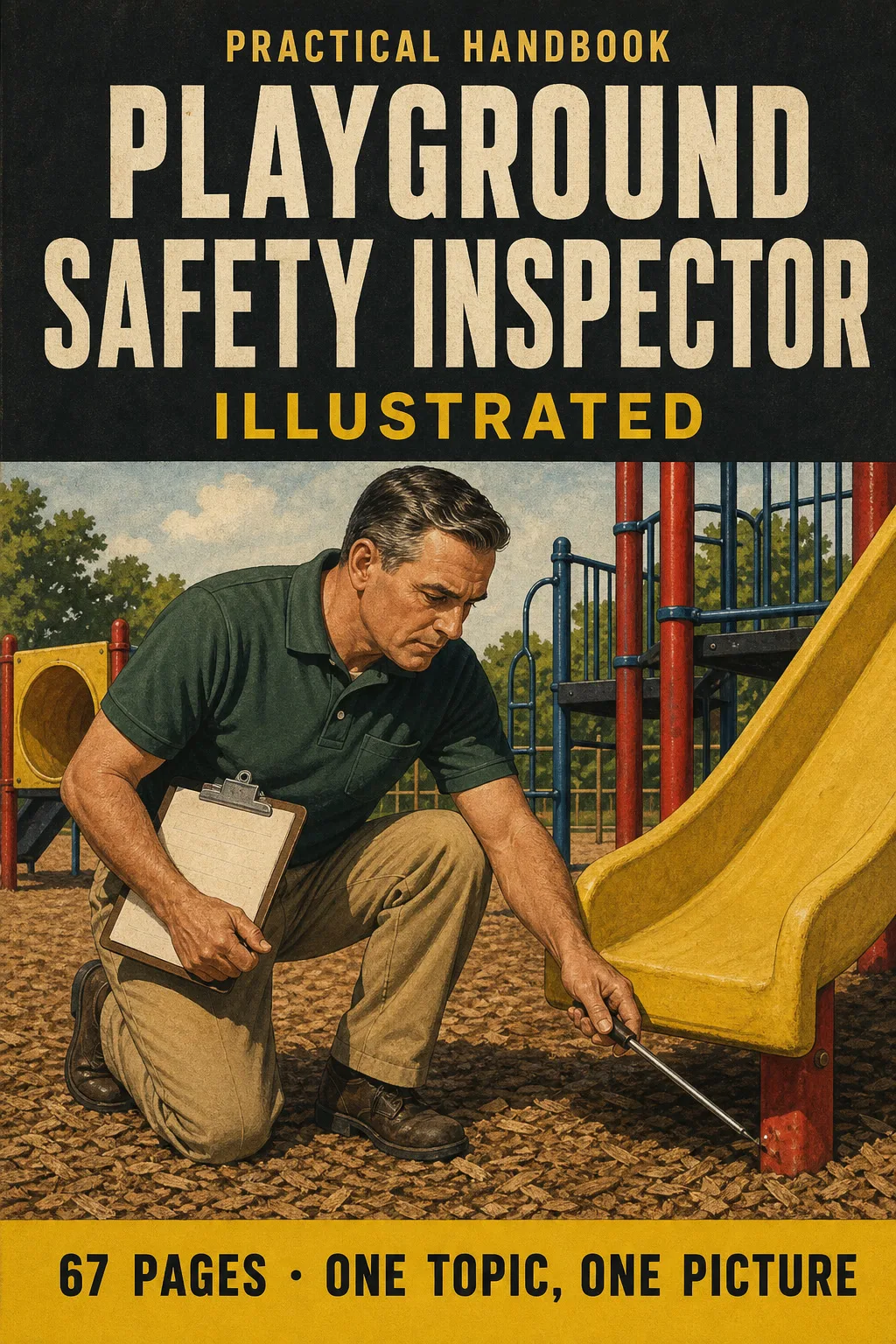
The Playground Safety Inspector Exam, Illustrated: Every Site Checked in the Same Order One Hazard Check per Page

Use zones, surfacing and fall height, head entrapment, protrusions, crush points, guardrails, slides and swings, ADA play areas and inspections. Every topic gets its own page: the drawing first, then what you need to remember. 67 illustrated pages.

START STUDYING THIS WAY

🔒 Secure checkout · PDF by email · 30-day guarantee

Every topic, its own pageEach hazard check drawn, with the explanation right beside it
67 illustrated pages9 parts, from what an inspection really is to exam day
Up-to-date sourcesCPSC Pub. 325, ASTM F1487 and the 2010 ADA Standards
PDF by emailFormat

Look Inside the Book

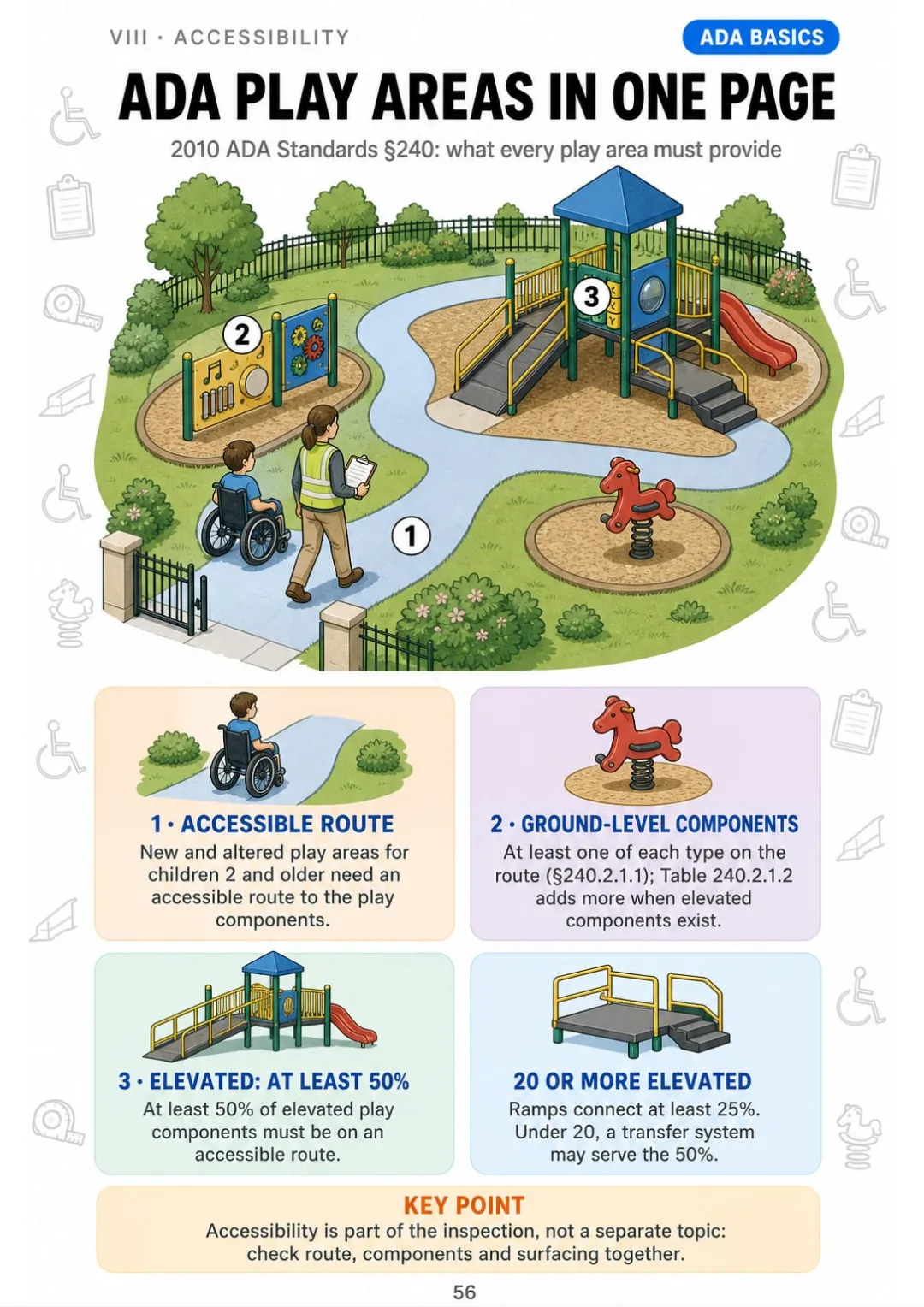
Every page has one big drawing and a box with the measurements you need to know:

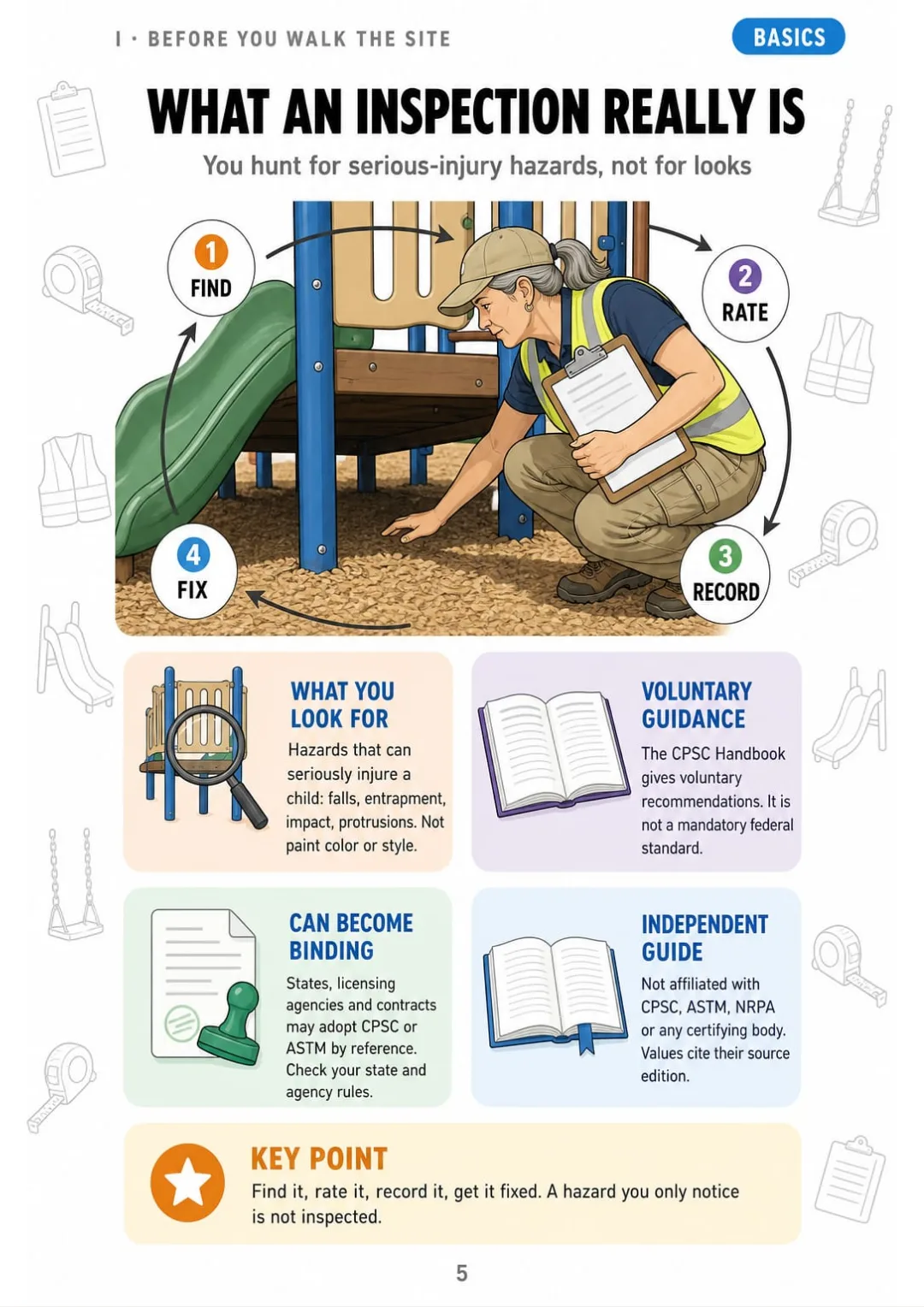
Falls, entrapment, impact, protrusions: find it, rate it, record it, fix it.
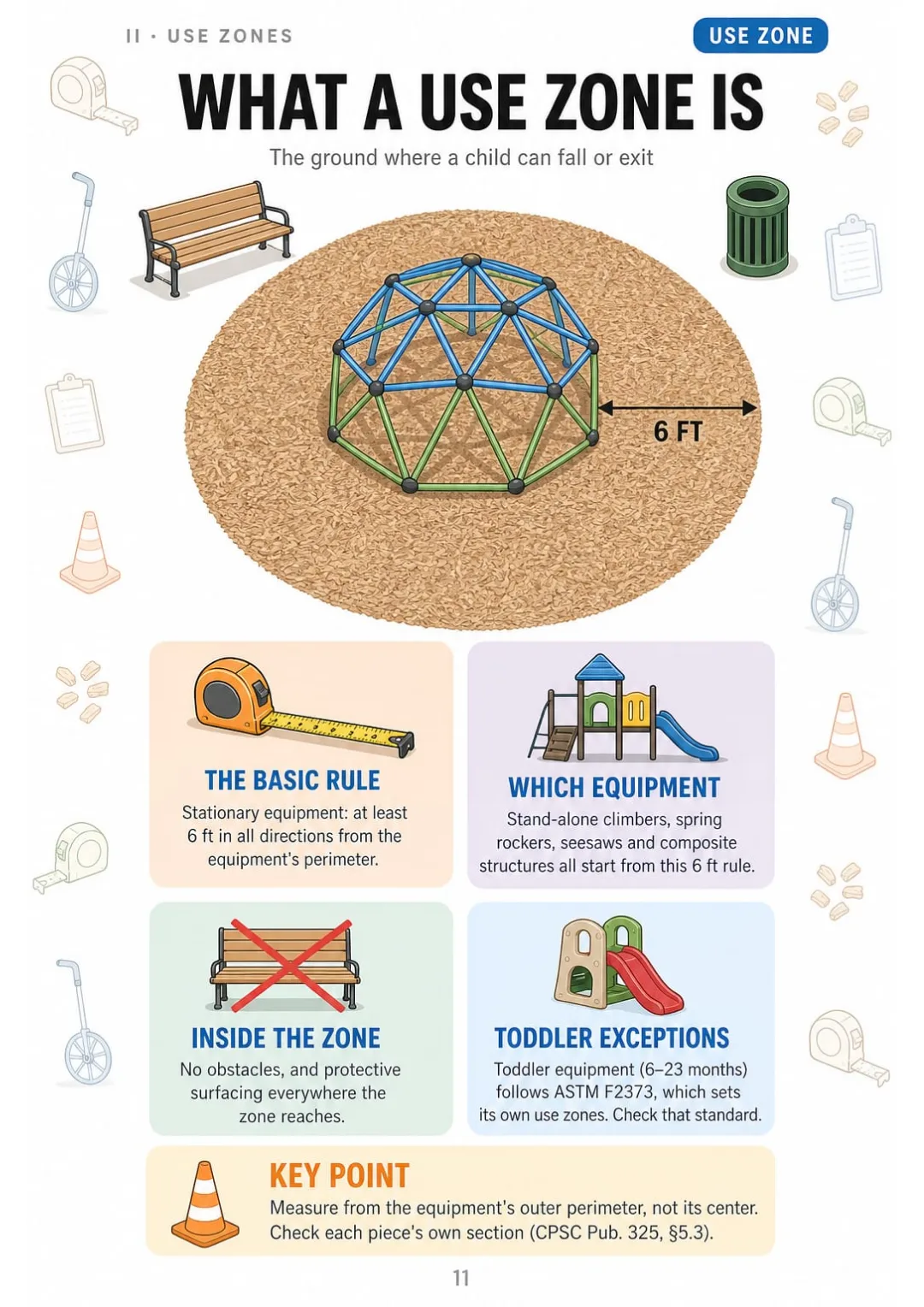
Stationary equipment: use zone of at least 6 ft in all directions (CPSC Pub. 325, 2025).
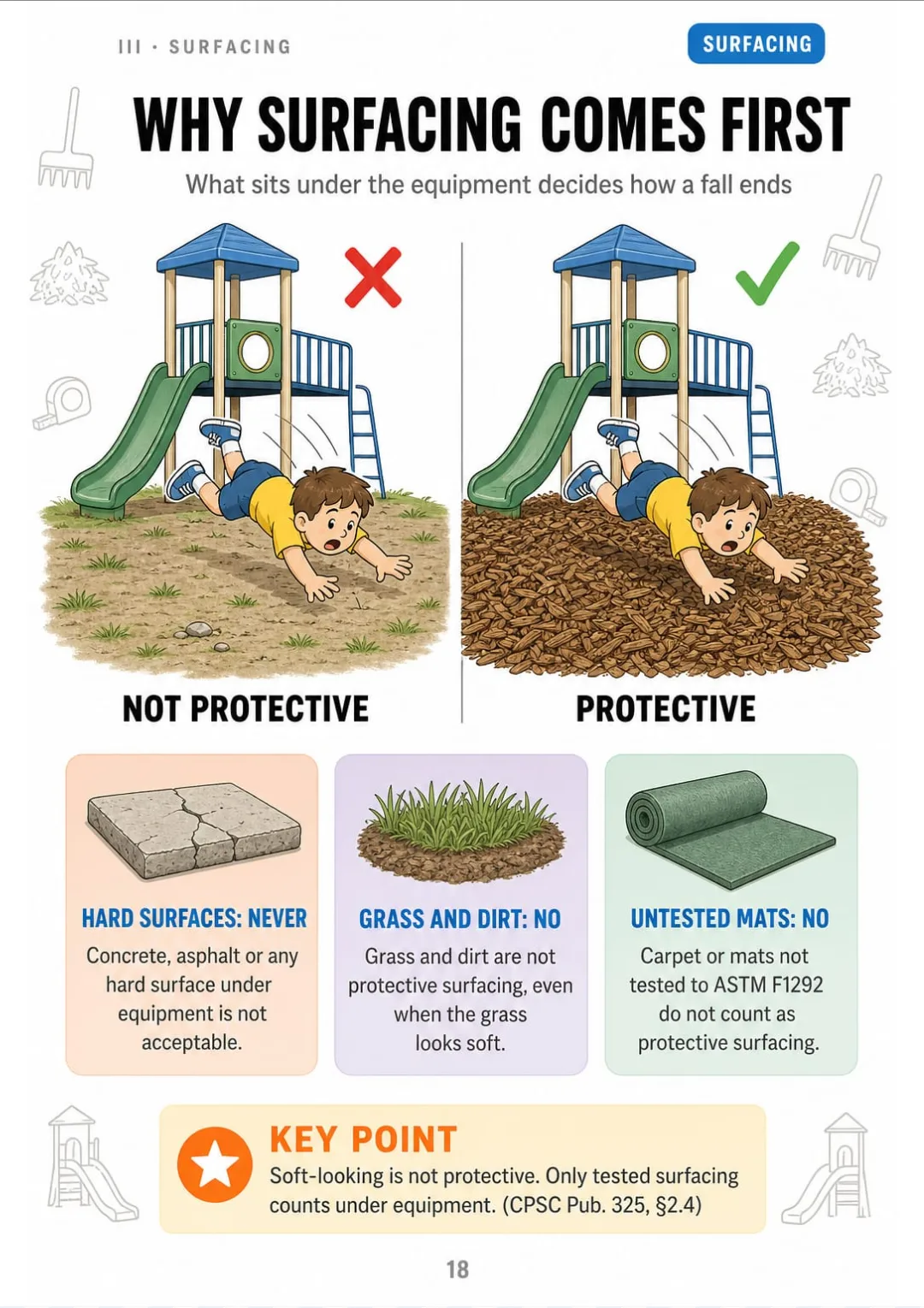
Concrete, asphalt, grass, dirt and untested mats: not protective surfacing (CPSC §2.4).
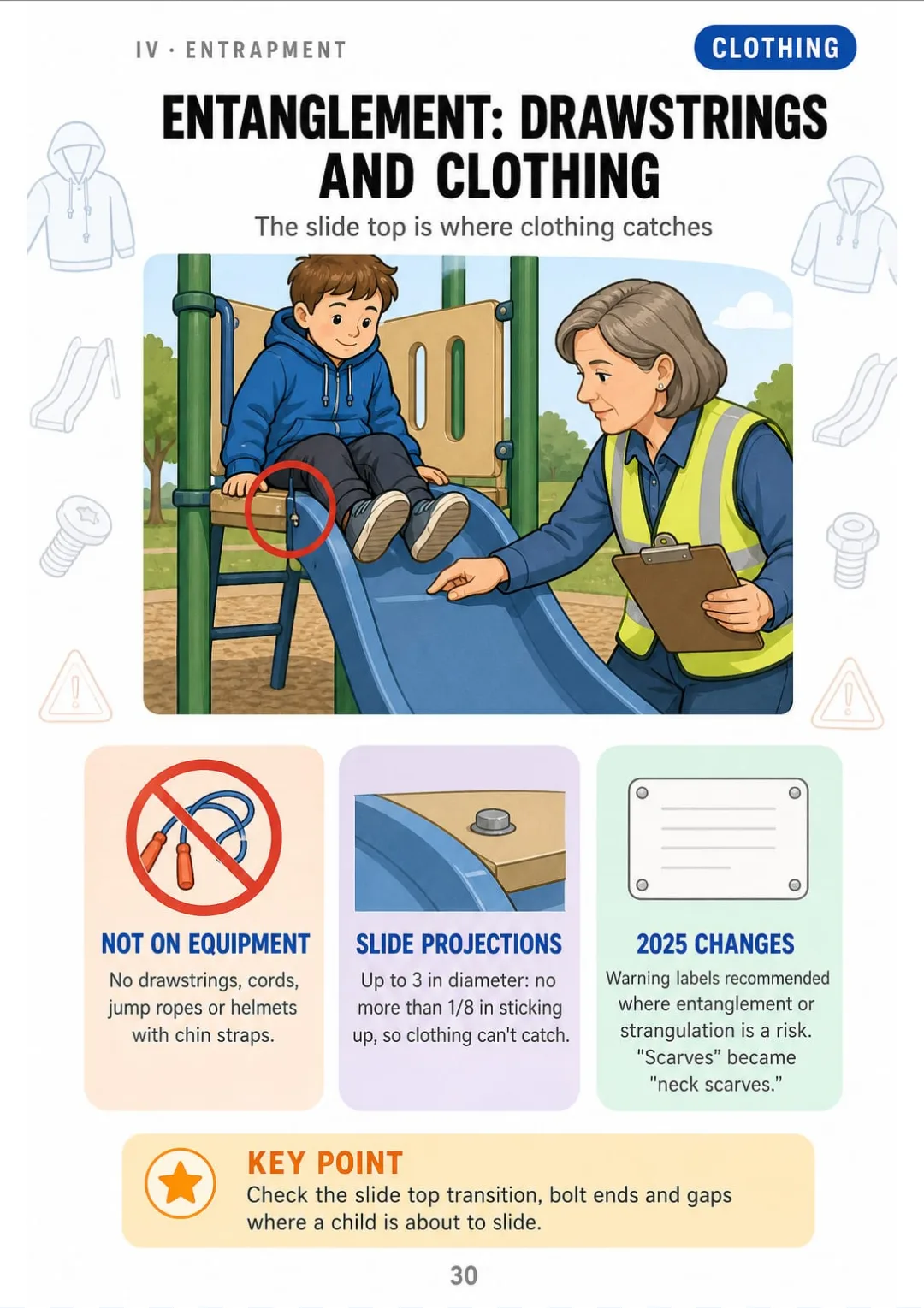
Slide projections max 1/8 in; no drawstrings, cords or chin-strap helmets (CPSC §3.2.1, §5.3.6.7).
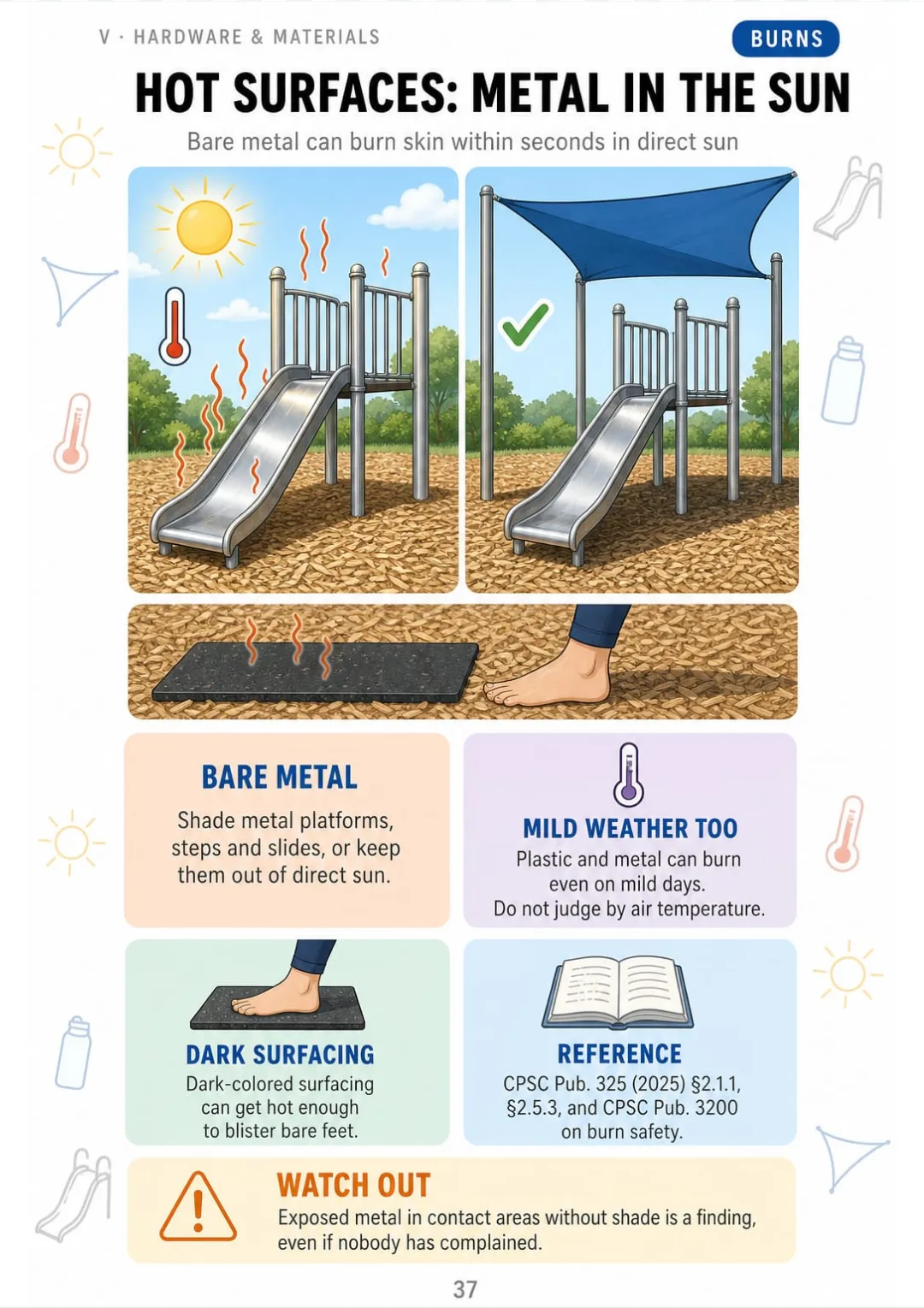
Shade bare metal decks, steps and slides: burns within seconds (CPSC Pub. 325, 2025)
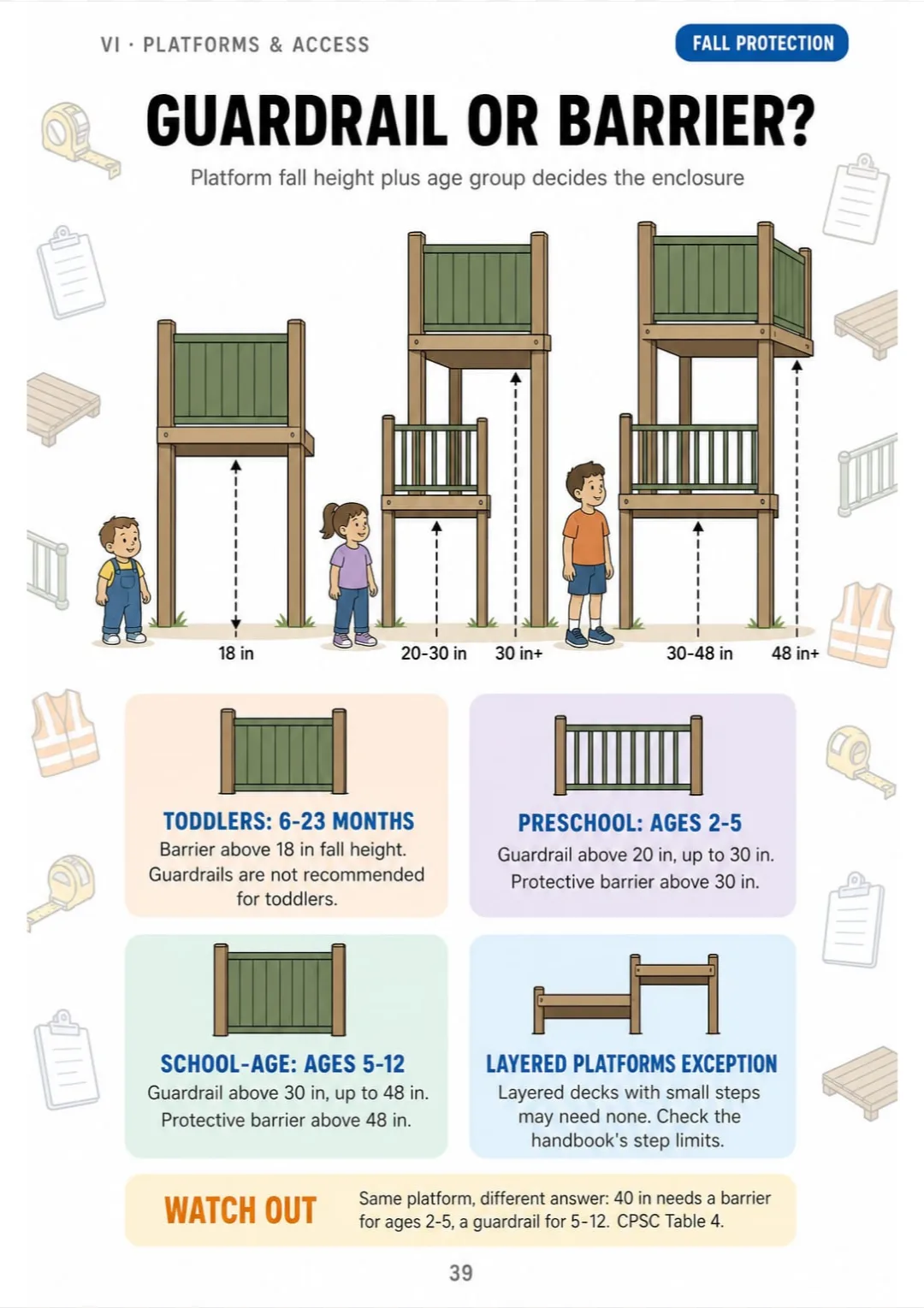
Barrier above 30 in for ages 2-5, above 48 in for ages 5-12 (CPSC Table 4).
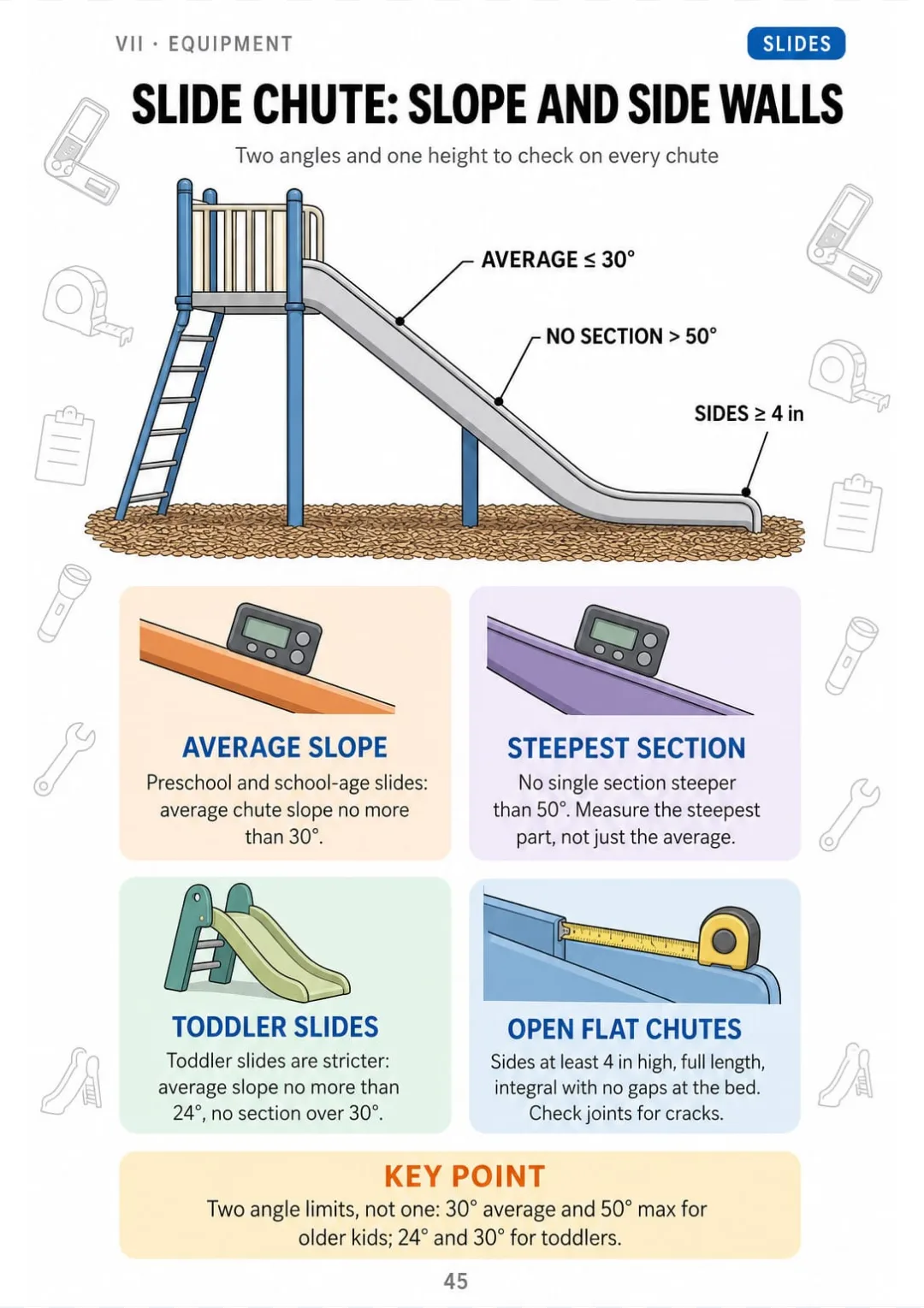
Chute slope: 30° average, 50° max section (toddlers 24°/30°); side walls ≥ 4 in · CPSC Pub. 325 §5.3.6.3.4
ADA §240.2.2: at least 50% of elevated components on an accessible route; 20+ need ramps to 25% (§1008.2)

Swipe to see more →

These are real pages from the book. The table of contents is the full one: 9 parts and 63 topics.

The Problem Isn't You. It's How It Was Explained to You.

You're standing under a climber with your clipboard. The ground is packed dirt with a thin rubber mat on top, and you have to decide: is this protective surfacing or not?

The handbook answers in paragraphs. Surfacing types, exceptions and cross-references, all in running text, with nothing to picture once you're out on the site.

Concrete, asphalt, grass, dirt and untested mats: not protective surfacing (CPSC §2.4).

In this book, surfacing is one page. Concrete, asphalt, grass, dirt and untested mats are drawn side by side and marked as not protective, so you see the answer before you read it.

Use zones, head entrapment openings, protrusions, guardrails and slide exits work the same way: each one has its own page and its own drawing.

So you look at the ground, you know the answer, and you write the finding without going back to the handbook.

COMPARE FOR YOURSELF

The Same Topic, Two Ways to Study It

THIS
  • The handbook: lines and lines of text
  • Use zones explained only in words
  • You show up to the exam with doubts
The use zone is defined as the surface under and around a piece of equipment onto which a child falling from or exiting the equipment would be expected to land. For stationary equipment, the use zone should extend a minimum of 6 feet in all directions from the perimeter of the equipment. The use zones of two adjacent stationary structures may overlap provided that the adjacent designated play surfaces of each structure are no more than 30 inches above the protective surfacing, subject to the additional provisions set forth below.
FOR THIS
  • The use zone in one drawing
  • The distances in feet in a box
  • You see it and you get it
Stationary equipment: use zone of at least 6 ft in all directions (CPSC Pub. 325, 2025).
CONTENTS

Take a Look at the 9 Parts and 63 Topics

Use zones, surfacing, entrapment, protrusions, guardrails, equipment by equipment, accessibility and the inspection routine: 67 pages, all illustrated, to review before the site walk.

IBefore You Walk the Site · pp. 5-10
  1. What a Playground Inspection Really Is
  2. CPSC Handbook vs. ASTM F1487
  3. Three Age Groups, Three Sets of Numbers
  4. Your Inspector Kit
  5. Hazard Priority: Not Every Defect Is Equal
  6. The Inspection Route: Always the Same Order
IILayout and Use Zones · pp. 11-17
  1. What a Use Zone Is
  2. When Use Zones Can Overlap
  3. To-Fro Swing Use Zone: Twice the Pivot Height
  4. Tire Swing Use Zone
  5. Slide Exit Zone
  6. Merry-Go-Rounds, Spring Rockers and Seesaws
  7. Site Layout: Separating Ages and Traffic
IIISurfacing and Fall Height · pp. 18-25
  1. Why Surfacing Comes First
  2. Fall Height: Where You Measure From
  3. Critical Height and ASTM F1292
  4. Loose Fill: Wood Mulch and Engineered Wood Fiber
  5. Loose Fill: Sand, Gravel and Shredded Rubber
  6. Compression: Install 12 to Keep 9
  7. Displacement: Where the Fill Disappears
  8. Unitary Surfaces: Rubber Tiles and Poured-in-Place
IVEntrapment and Entanglement · pp. 26-32
  1. Head and Neck Entrapment: 3.5 to 9 Inches
  2. Using the Torso and Head Probes
  3. Partially Bound and V-Shaped Openings
  4. Finger Entrapment: 3/8 to 1 Inch
  5. Entanglement: Drawstrings and Clothing
  6. Crush and Shear Points
  7. Suspended Hazards: Cables, Ropes and Chains
VProtrusions, Hardware and Materials · pp. 33-38
  1. Protrusions and the Gauges
  2. S-Hooks and Hardware
  3. Sharp Edges and Points
  4. Tripping Hazards
  5. Hot Surfaces
  6. Materials: Wood, Paint and Corrosion
VIPlatforms, Guardrails and Access · pp. 39-44
  1. Guardrail or Barrier? It Depends on Height and Age
  2. Guardrail and Barrier Dimensions
  3. Platform Height Changes
  4. Stairs and Ladders
  5. Ramps and Handrails
  6. The Gaps People Miss on Decks
VIIEquipment by Equipment · pp. 45-55
  1. Slides: Chute and Side Walls
  2. Slides: Platform, Entrance and Exit
  3. Tube, Spiral and Roller Slides
  4. To-Fro Swings: Clearances
  5. Swing Seats and Placement
  6. Tire Swings
  7. Upper Body Equipment
  8. Climbers and Sliding Poles
  9. Merry-Go-Rounds and Spring Rockers
  10. Seesaws
  11. Equipment the Handbook Does Not Recommend
VIIIAccessibility · pp. 56-59
  1. ADA Play Areas: The Rules in One Page
  2. Accessible Route and Surfacing
  3. Ground-Level Play Components
  4. Elevated Components: Ramps or Transfer Platforms
IXInspection Routine and Exam Review · pp. 60-67
  1. How Often to Inspect
  2. Writing a Finding That Gets Fixed
  3. Records and Repairs
  4. The Visual Walk: 10 Things in 10 Minutes
  5. The Full Audit Step by Step
  6. The Most Frequent Mistakes Inspectors Make
  7. The Numbers on One Page
  8. Exam Day: Read the Question Like an Inspector

One Page, One Topic, All Clear

Think of it this way:

It's the annual audit at an elementary school. The swing set is new, and before you mark it pass, you need to know how far its use zone runs to the front and back.

You open the swing use zone page and there it is: the pivot point, the zone stretching twice the pivot height in front and behind, with the distances in feet.

Shade bare metal decks, steps and slides: burns within seconds (CPSC Pub. 325, 2025)

Same with head entrapment, surfacing depth, guardrail heights, slide exits and ADA routes: each one on its own page, drawn the way you see it on site.

Playground Safety Inspector Illustrated is 9 parts and 63 topics, all drawn, and it closes with every key number on one page, the full audit step by step and an exam-day review.

What you see drawn, you don't have to memorize.

What's Inside Playground Safety Inspector Illustrated:

Ipp. 5-10

Before You Walk the Site

What an inspection really is, CPSC handbook vs. ASTM F1487, the three age groups, your inspector kit, hazard priority and the route you always follow.

IIpp. 11-17

Layout and Use Zones

What a use zone is, when zones can overlap, swing, tire swing and slide exit zones, merry-go-rounds, rockers, seesaws and site layout.

IIIpp. 18-25

Surfacing and Fall Height

Why surfacing comes first, where fall height is measured, critical height, loose fill and unitary surfaces, compression and displacement.

IVpp. 26-32

Entrapment and Entanglement

Head and neck entrapment, the torso and head probes, partially bound and V-shaped openings, fingers, drawstrings, crush and shear points and suspended hazards.

Vpp. 33-38

Protrusions, Hardware and Materials

Protrusions and the gauges, S-hooks and hardware, sharp edges, tripping hazards, hot surfaces and materials, paint and corrosion.

VIpp. 39-44

Platforms, Guardrails and Access

Guardrail or barrier by height and age, their dimensions, platform height changes, stairs, ladders, ramps, handrails and the gaps people miss on decks.

VIIpp. 45-55

Equipment by Equipment

Slides, swings, tire swings, upper body equipment, climbers and sliding poles, merry-go-rounds, spring rockers, seesaws and equipment the handbook does not recommend.

VIIIpp. 56-59

Accessibility

ADA play area rules on one page, the accessible route and its surfacing, ground-level components, and ramps or transfer platforms for elevated ones.

IXpp. 60-67

Inspection Routine and Exam Review

How often to inspect, writing a finding that gets fixed, records and repairs, the 10-minute visual walk, the full audit, frequent mistakes, the numbers on one page and exam day.

At the end of the book: Every key number on one page, the full audit step by step and an exam-day review.
Plus: 2 Free Books

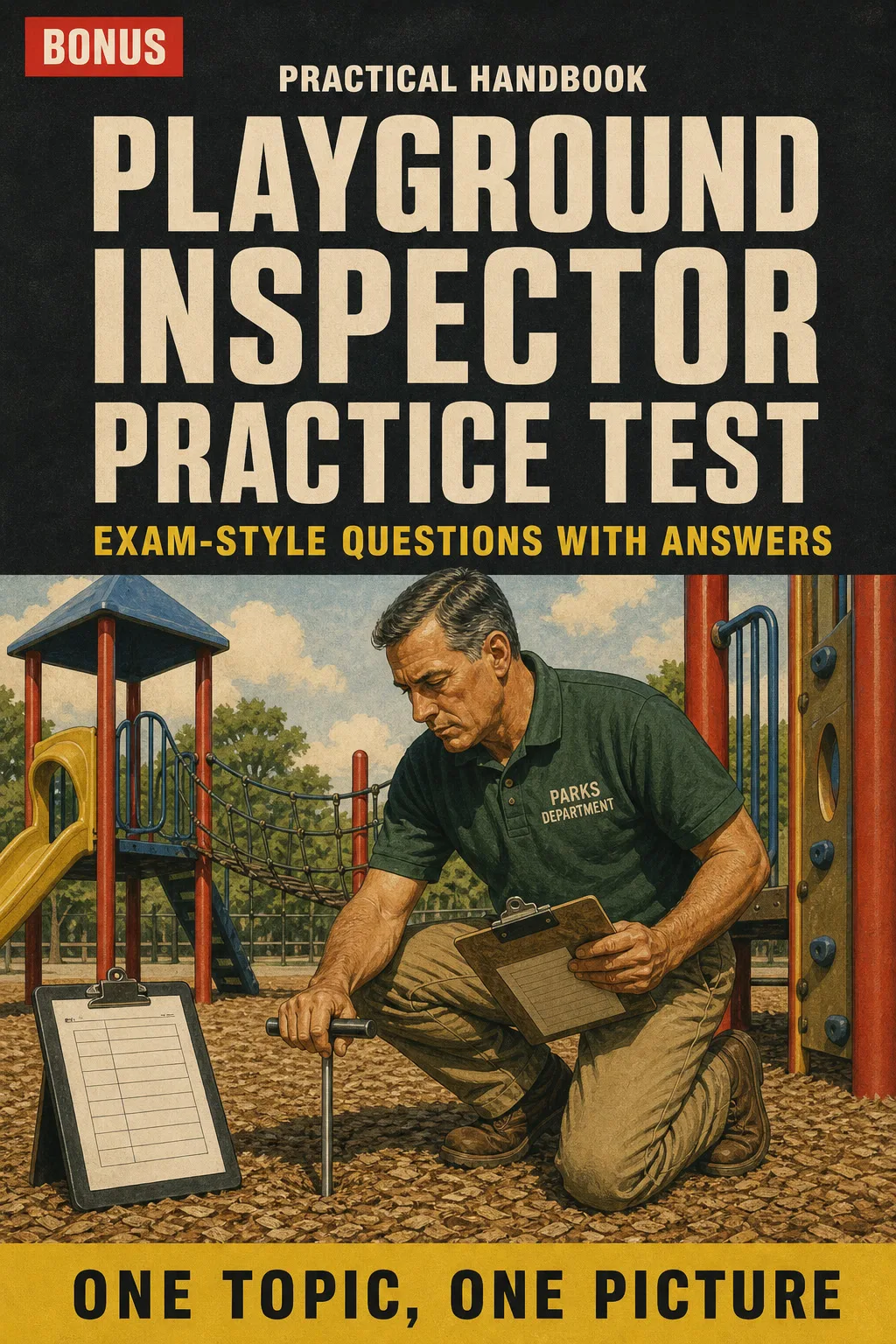
Playground Inspector Practice Test: Exam-Style Questions with Answers

BONUS 1: «Playground Inspector Practice Test: Exam-Style Questions with Answers»

Value on its own: US$ 17.90

Test yourself before exam day: every answer is explained in one line and points to the page where it's drawn.

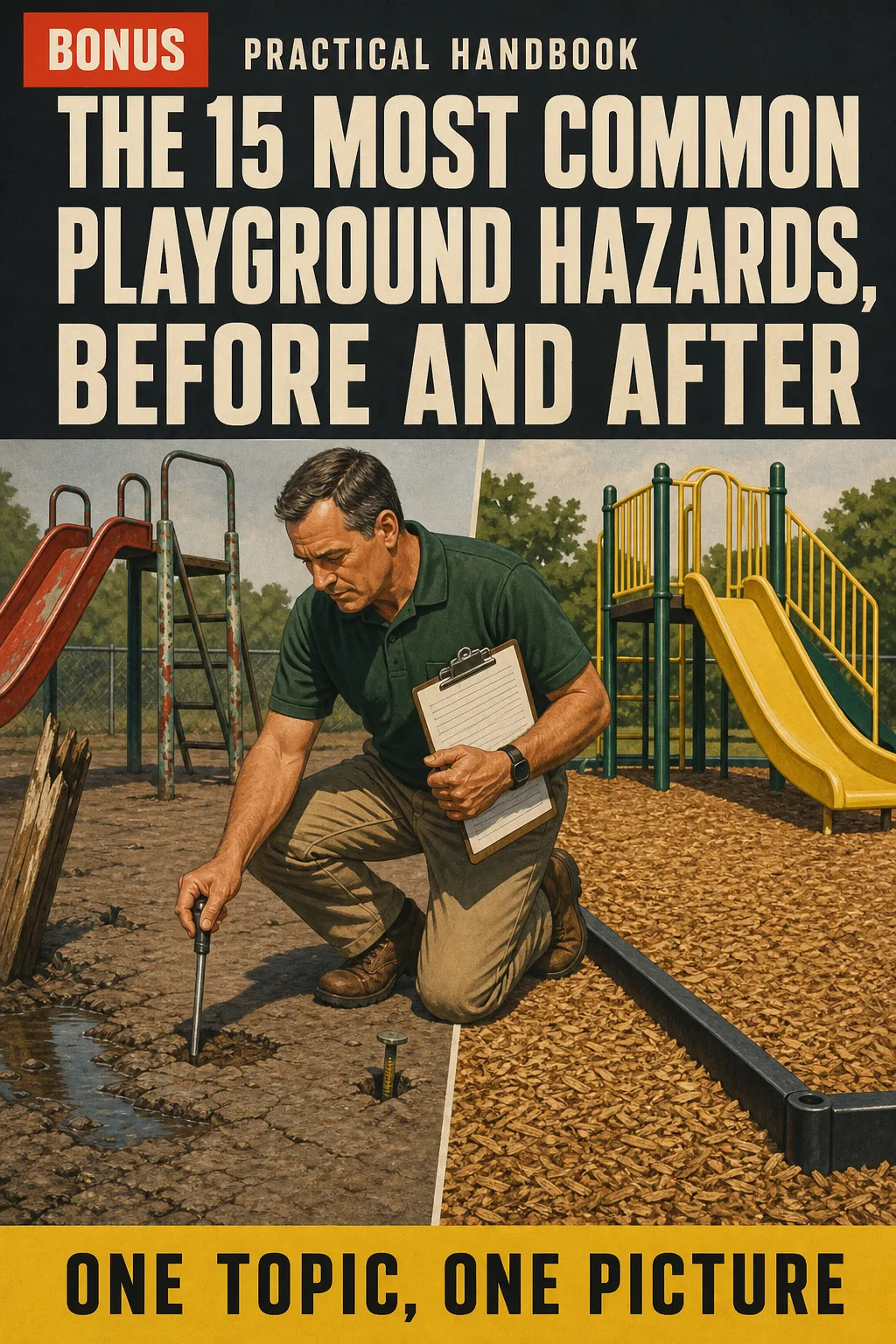
The 15 Most Common Playground Hazards, Before and After

BONUS 2: «The 15 Most Common Playground Hazards, Before and After»

Value on its own: US$ 14.90

See the hazards found most often on inspections drawn side by side, wrong and fixed, so you spot them at a glance.

Playground Safety Inspector Illustrated with 2 Free Books

  • Playground Safety Inspector Illustrated: 67 illustrated pagesUS$ 63
  • BONUS 1: Playground Inspector Practice Test: Exam-Style Questions with AnswersUS$ 17.90
  • BONUS 2: The 15 Most Common Playground Hazards, Before and AfterUS$ 14.90
  • High-resolution PDF to printIncluded
Total value US$ 95.80
YOUR PRICE:
US$ 27
You save US$ 68.80
YES, I WANT PLAYGROUND SAFETY INSPECTOR ILLUSTRATED FOR US$ 27

📄 This is a digital PDF book sent to your email: nothing is printed or shipped.

Secure purchaseEncrypted payment30-day guarantee

PDF by email: We email you Playground Safety Inspector Illustrated as a PDF, together with the two free books. It's a single payment: no installments, no extra charges.

Who This Book Is For

You're studying for the certification

You're studying for the certification

Every topic of the handbook on its own page and in the order you walk a site, so what you study at night is what you check the next morning.

Your exam date is close

Your exam date is close

The numbers on one page, the frequent mistakes and a practice test with answers that point to the page where each one is drawn.

You already inspect or install playgrounds

You already inspect or install playgrounds

A printable reference for the clipboard: use zones, surfacing depths, entrapment ranges and guardrail heights, ready to check in the field.

Everything You Get Today

US$ 95.80US$ 27
YES, I WANT PLAYGROUND SAFETY INSPECTOR ILLUSTRATED FOR US$ 27

📄 This is a digital PDF book sent to your email: nothing is printed or shipped.

30DAYS
GUARANTEE

30-Day Guarantee

Try Playground Safety Inspector Illustrated for 30 days, bonus books included.

We refund everything if the file won't open, if the book isn't what you see here, if you were charged twice or if the email doesn't arrive. Just email us.

You pay once. No subscriptions.

Frequently Asked Questions

Is it for me if I've been fixing and installing playground equipment for years?

Yes. It isn't a beginner book: it puts the handbook in the order you inspect a site, with every measurement drawn, so the experience you already have gets a structure for the exam.

Where does the content come from?

From the edition of the CPSC Public Playground Safety Handbook (Pub. 325) that CPSC currently publishes, ASTM F1487 and related standards (F1292, F2223, F2373, F1951) and the 2010 ADA Standards. It's written for US playgrounds, in feet and inches, and each key value names the section it comes from, so you can check it against your copy of the handbook or a new edition.

Is this official material?

No. It's an independent study guide, not affiliated with or endorsed by NRPA, CPSC, ASTM or any certifying body.

Does it replace the certification course?

No. It doesn't give you a certificate or count toward one: certification comes only from the official course and exam. This book helps you study and review alongside the course, the current CPSC handbook and the ASTM standards.

Are the practice questions the ones on the exam?

No. They're written for this book to help you practice, and they're not official questions from any exam.

When and how do I get it?

As a PDF by email, sent to the address you enter at checkout. The two gift books come the same way.

Do I have to pay every month?

No. It's a one-time payment.

Can I get it on paper?

It comes as a PDF made to print. Print it at home or at a print shop and take it to the site.

How does the refund work?

You have 30 days. We refund everything if the file won't open, if the book isn't what you see on this page, if you were charged twice or if the email doesn't arrive: just email us.

Before You Close This Page

No more rereading and retaining nothing.

The surfacing under the climber: you see it drawn, and that's it.

You walk into the exam knowing where everything is.

Drawings make studying faster.

The book is right below.

One-time payment: US$ 27 · Guarantee: 30 days · PDF by email

YES, I WANT PLAYGROUND SAFETY INSPECTOR ILLUSTRATED FOR US$ 27

📄 This is a digital PDF book sent to your email: nothing is printed or shipped.